Colorado Family Law Attorneys
Navigating the dissolution of a marriage or a dispute over child custody is rarely simple. It is often one of the most emotionally taxing experiences a person will face in their lifetime. Whether you are filing for divorce in Denver District Court or seeking a modification of parenting time in Boulder County Court, the legal process can feel overwhelming without proper guidance.
At Jorgensen, Brownell & Pepin, P.C. (JBP), we understand that family law is not just about statutes and courtrooms; it is about the restructuring of your life. Established in 1989, our firm has spent over 30 years providing pragmatic advocacy for families across Northern Colorado. As a family-owned firm with offices in Longmont, Denver, Broomfield, and Loveland, we believe that successful outcomes are built on a foundation of client education, strategic negotiation, and—when absolutely necessary—vigorous litigation.
The goal of family law is not to destroy the opposition, but to reach a resolution that allows all parties to move forward with financial stability and peace of mind.


Don't Face Difficult Family Law Issues Alone
Complex family legal issues can be emotionally, mentally, and physically exhausting. Problems such as parenting time or guardianship of grandchildren, modification of past divorce orders, or collection of past-due support can be complex and confusing if you're not used to the legal system. And even if you want to reach an agreement, the processes needed to reach that agreement officially can be daunting.
To make your family law case easier for everyone, contact Jorgensen, Brownell & Pepin, P.C. Our experienced family law attorneys will stand by your side and help you navigate the system, no matter what complexities are on the horizon.
Why Choose Jorgensen, Brownell & Pepin, P.C.?
When you are searching for legal help for families in Denver, experience matters. Our legal team of Colorado family law attorneys is passionate about protecting your rights. Here's why clients choose us:
- Coverage: With offices in Longmont, Denver, Broomfield, and Loveland, we effectively serve clients across the entire Front Range, understanding the nuances between local county judges and district magistrates. Our service area covers numerous counties including Larimer, Weld, Adams, Jefferson, Arapahoe, Douglas, and more.
- Full-Service Team: Because we are a multi-practice firm, we can assist if your divorce intersects with other legal areas, such as real estate transfers, business valuations, or estate planning updates.
- Client Education: We believe an informed client makes better decisions. We take the time to explain the "why" behind the legal strategy.
- Proven Track Record: We've helped hundreds of Colorado families as experienced litigators and negotiators.
- Trusted Name Since 1989: Over 30 years of dedicated family law service.

If you need assistance with any family law issue, we're here to help. We can guide you through each step of the process, protect your rights and interests, and enable you to make well-informed decisions.
What Does a Family Lawyer Do?
To understand how a lawyer can help, it is essential to define the role within the context of Colorado law.
Definition: A family law attorney in Denver represents clients in domestic relations cases governed by C.R.S. Title 14. Their role encompasses legal counseling, drafting settlement agreements, navigating procedural requirements of the local courts, and advocating for the client's financial and parental rights during mediation or trial.
While television often portrays family lawyers solely as litigators in a courtroom, the reality is that a significant portion of the work involves discovery, financial analysis, and negotiation to avoid trial.
Types of Family Law Cases We Handle
Our Colorado family lawyers have over 30 years of experience handling a wide range of divorce and family law cases governed by C.R.S. Title 14, including:
Divorce
Ending a marriage is never easy. But we can make it far less stressful. Let our experienced Colorado divorce attorneys guide you through this challenging life transition.
Divorce Dissolution involves the legal termination of a marriage. This includes the division of assets and debts, determination of spousal support, and allocation of parental responsibilities.
Legal Separation
A process similar to divorce where the parties divide assets and determine custody, but the marriage remains legally intact. This is often chosen for religious reasons or to maintain health insurance benefits.
Child Custody (Allocation of Parental Responsibilities)
You should be a part of your child's life after a divorce. With a fair parenting time order, you can be. Let us help you create the best parenting plan for your child.
Commonly referred to as "custody," this covers decision-making authority and parenting time schedules for parents who are divorcing or who were never married.
Child Support
Whether you need to pay child support or are entitled to receive it, our lawyers can assist you through the process. We are dedicated to ensuring a fair and equitable child support arrangement that meets your family's needs.
Post-Decree Modifications
Life changes after a divorce is final. If a parent relocates, loses a job, or a child's needs change, lawyers assist in modifying existing court orders regarding child support or parenting time.
Paternity
Establishing legal fatherhood to secure parenting rights or child support.
Adoption
Looking to extend your family through adoption? Let us be your trusted guide. Our team will ensure a seamless experience that allows you to focus on your family—not the complex legal process.
Domestic Violence
Victims of domestic violence can come to our firm for help filing for restraining and protective orders. Our trial experience and criminal defense backgrounds also mean we are capable of defending people from domestic violence accusations.
Fathers' Rights
Our courts now recognize the importance fathers play in raising children. We're here to provide the court with the necessary information to uphold your rights and ensure you maintain a deep, meaningful connection with your children.
Mothers' Rights
Despite years of making strides, mothers are still more likely to have given up careers to be with their children. Our lawyers know what's necessary to get the court to support these parents in their reentry into the workforce and create fair parenting plans. Rather than struggle through a divorce or child custody dispute, we empower clients to take control.
Grandparents' Rights/Visitation
We understand how important grandparents are in a child's life. Our experienced legal team is dedicated to advocating on behalf of grandparents to ensure they receive the proper visitation arrangements. We can also petition to get custody of grandchildren if there is reason to believe a biological parent cannot provide adequate care.
Marital Prenuptial Agreements
Planning for the future is essential, especially when it comes to marriage. You can solve potential divorce complications before you marry by drafting a prenuptial agreement. We'll protect your rights and assets before, during, and after marriage.
Property Division
Splitting up your shared property in a divorce must be done fairly in Colorado, not necessarily equally. We are here to help determine what would be equitable and argue before the court for it if need be.
Spousal Maintenance
Financial support for a lower-earning spouse designed to help them meet their reasonable needs while they become self-sufficient.
Understanding Colorado Divorce Law
Colorado is a "No-Fault" divorce state. This is a critical concept for clients to understand, as it shifts the focus of the legal proceedings away from "blame" and toward "resolution."
Under Colorado law, you do not need to prove that your spouse committed adultery, abandonment, or abuse to obtain a divorce. The only ground required for the dissolution of marriage is that the marriage is "irretrievably broken." If one party asserts that the marriage is broken and cannot be saved, the court will generally grant the divorce, regardless of whether the other spouse wants to stay married.
Residency Requirements
Before filing for legal help for families in Denver, you must meet the state's jurisdictional requirements. To file for a dissolution of marriage in Colorado:
- At least one spouse must have been domiciled in Colorado for at least 90 days prior to filing the petition.
- If children are involved, the children must generally have lived in Colorado for at least 182 days (six months) prior to filing for the court to have jurisdiction over child custody matters.
Is Colorado a 50/50 State for Divorce?
One of the most common misconceptions in family law is that assets are automatically split down the middle.
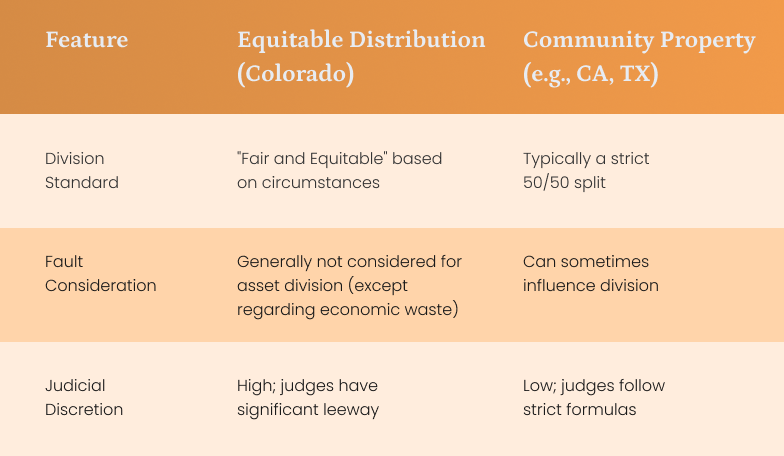
Answer: No, Colorado is not a "community property" (50/50) state. It is an "Equitable Distribution" state. This means the court divides property in a manner deemed fair, which does not always mean equal.
The court looks at the economic circumstances of each spouse to determine a division that is equitable. In some cases, a 50/50 split is fair; in other cases the court finds a different division to be more fair.
Equitable Distribution vs. Community Property
Marital Property vs. Separate Property
Before assets can be divided, they must be classified. C.R.S. 14-10-113 governs the disposition of property.
- Separate Property: Assets acquired before the marriage, or acquired during the marriage by gift or inheritance. These generally remain with the original owner, except for the increase in value of that property during the marriage.
- Marital Property: Almost everything acquired by either spouse during the marriage, regardless of whose name is on the title. This includes real estate, retirement accounts (401k, PERA), vehicles, and business interests.
The Contribution Factor: When determining how to divide marital property, the court considers the contribution of each spouse to the acquisition of the property. Crucially, Colorado law explicitly recognizes the contribution of a spouse as a homemaker. This ensures that a stay-at-home parent's efforts in maintaining the home and raising children are viewed as equal in value to the financial contributions of the working spouse.
Allocation of Parental Responsibilities (APR) Explained
While many people still use the terms "custody" and "visitation," Colorado law has updated its terminology to Allocation of Parental Responsibilities (APR). This shift reflects a focus on the responsibilities parents have toward their children rather than the "possession" of the child.
In any APR case, the court's primary standard is the "Best Interests of the Child" (C.R.S. 14-10-124). The court does not prioritize the mother or the father; it prioritizes the child's physical and emotional well-being.
Decision-Making vs. Parenting Time
APR is divided into two distinct categories. A Colorado divorce lawyer will help you negotiate these separately:
1. Decision-Making Responsibility
This refers to the authority to make major decisions regarding the child's upbringing. It is usually categorized into:
- Medical/Health: Selection of doctors, therapists, and treatments.
- Education: Choice of schools, tutors, and special education.
- Religion: Religious upbringing and participation.
- Extracurriculars: Participation in sports, music, or camps.
Decision-making can be sole (one parent decides) or joint (parents must agree). Courts generally presume joint decision-making is in the child's best interest unless there is a history of domestic violence or inability to co-parent.
2. Parenting Time
This refers to the physical schedule—where the child sleeps at night.
- 50/50 Schedules: Common arrangements include week-on/week-off or a 5-2-2-5 rotation.
- Primary/Secondary: One parent has the majority of overnights (e.g., school nights), while the other has weekends and holidays.
Parenting time directly impacts child support calculations. The number of overnights a parent has is a key variable in the child support worksheet.
Solving Family Disputes: Mediation vs. Litigation
At Jorgensen, Brownell & Pepin, P.C., our philosophy is rooted in Pragmatic Advocacy. We recognize that aggressive litigation is expensive, stressful, and often damaging to future co-parenting relationships.
The Role of Mediation
In all Colorado district courts in Denver and Boulder, mediation is mandatory before a judge will hear a contested case. Mediation is a confidential process where a neutral third party helps the couple reach a settlement.
- Cost-Effective: Mediation costs significantly less than trial preparation.
- Control: You and your spouse retain control over the outcome, rather than handing the decision to a judge who doesn't know your family.
When Litigation is Necessary
While we prioritize negotiation, we are trial attorneys at heart. Litigation becomes necessary when:
- One party is hiding assets or refusing to disclose financial data.
- There are safety concerns involving domestic violence or substance abuse.
- The opposing party holds unreasonable expectations that deviate significantly from Colorado law.
In these instances, having a team experienced in Domestic Relations litigation is vital to protect your interests.
Financial Support: Maintenance and Child Support
Financial separation is often the most complex aspect of a divorce.
Spousal Maintenance (Alimony)
In Colorado, spousal maintenance is not automatic. It is designed to help a lower-earning spouse meet their reasonable needs while they become self-sufficient.
- The Guidelines: For couples with a combined income under a certain threshold (currently $240,000/year adjusted for inflation), Colorado provides an advisory formula based on the length of the marriage and the disparity in income.
- Duration: Maintenance is rarely permanent unless the marriage was very long (20+ years). Typically, the duration is a percentage of the length of the marriage (e.g., for a 10-year marriage, maintenance might last 5 years).
Child Support
Unlike maintenance, Child Support is not optional or negotiable in the same way. It is the right of the child, not the parent.
- Income Shares Model: Colorado uses a formula that estimates how much the parents would have spent on the child if they had remained together.
- Factors: Gross incomes of both parents, number of overnights, health insurance costs, and daycare expenses are plugged into the statutory worksheet to produce a monthly figure.
Frequently Asked Questions
Do I need to prove the reason for the divorce?
You do not need to prove any grounds for divorce in Colorado. The spouse filing for divorce must simply tell the court that the marriage is "irretrievably broken." There is no need to prove that there was infidelity, abuse, or gross financial mismanagement to get a divorce.
How long does a divorce take in Colorado?
A divorce in Colorado takes a minimum of 91 days. This is a statutory "cooling-off" period that begins once the petition is filed and the other party is served (or signs a waiver). However, contested divorces involving complex assets or custody disputes often take 6 to 12 months to finalize.
How do Colorado family law courts split parenting time?
Colorado's statute specifically states that although it recognizes that shared parenting isn't always appropriate, generally, it is in the best interest of all parties to encourage frequent and continuing contact between each parent and the children. The court then hears evidence to determine individually what would be best for the children in each case. Many factors, such as domestic violence, substance abuse, work schedules, and living location, affect the court's decisions.
Do mothers get priority in child custody orders?
Neither mothers nor fathers have priority in child custody cases. The court prioritizes the child's best interests when making custody orders, emphasizing the child's needs over those of the parents.
What is marital property in a divorce?
All assets and debts accumulated while married are presumed to be marital property. There are a few exceptions, including inheritances and gifts. However, even inheritances or gifts can become marital property if used in certain ways, such as purchasing a joint asset. During a divorce, the court will divide all marital property equitably.
How is paternity established?
Paternity can be established in three ways in Colorado:
- Automatic assignment: Paternity is automatically assigned to the man who is married to a woman when she gives birth unless he denies paternity at the time of birth.
- Voluntary assignment: Paternity can be voluntarily assigned if both parents agree.
- Court order: A court order can assign paternity, such as in a contentious divorce, after a paternity test and analysis of the child's relationship with each possible father is conducted.
Can I move out of state with my child?
You cannot simply move a child out of state if a custody order is in place or a divorce is pending. You must obtain either the written consent of the other parent or a court order. Relocation cases are among the most difficult in family law; the court will heavily scrutinize whether the move is in the child's best interest and how it impacts the relationship with the non-relocating parent.
Do I need a lawyer for an uncontested divorce?
While you are not legally required to have a lawyer, it is highly recommended. Even in "amicable" divorces, unrepresented parties often make mistakes in drafting the Separation Agreement or parenting plan that can have long-term financial consequences or require expensive modifications later. A "review counsel" can look over your agreement to ensure your rights are protected before you sign.
Family Law Specialties
- Adoption
- Child Custody
- Child Support
- Domestic Violence
- Divorce
- Fathers' Rights
- Grandparents' Rights/Visitation
- Mothers' Rights
- Marital Prenuptial Agreements
- Paternity
- Property Division
- Spousal Maintenance
Get more information about our family law representation
We’ve Helped Others Like You









Get The Help You Need
Get JBP Legal’s experience on your side. Contact us for questions or a consultation.